Payment plan or try before you buy? Email Sylvia.
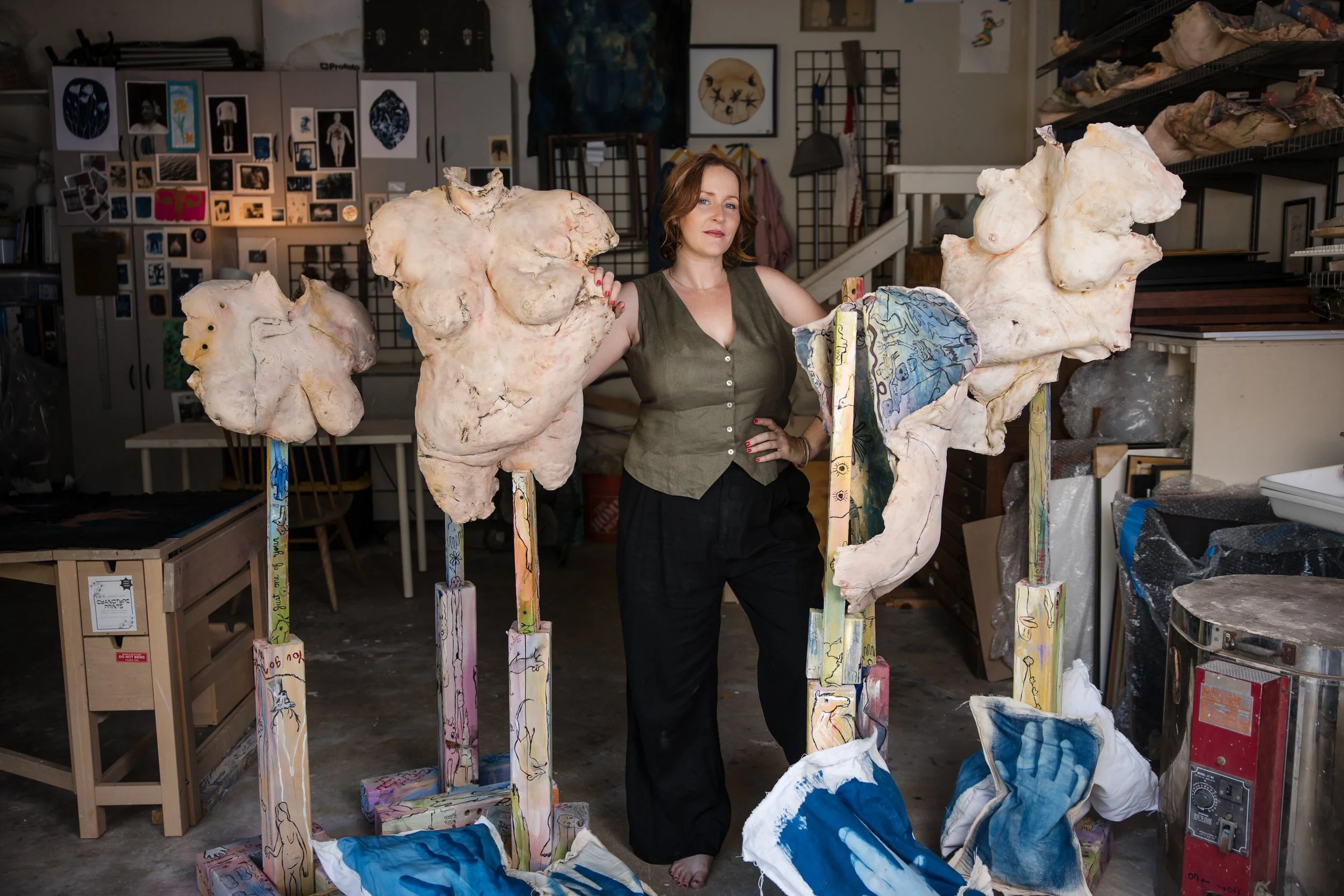
Ceramic sculpture, part of the collection Swimming Without Limbs. Low fire underglaze and glaze.
Dimensions: 17” x 5.5” x 7”
Materials: ceramic, low fire underglaze and glaze
Year: 2025
Artist Statement
My sculptural work explores the lingering impacts of addiction through the perspective of a witness: a daughter, a partner, a bystander. I lost my father to alcoholism and drug use, and at 30, left an abusive household to escape an addict husband. These experiences shaped how I respond to the world and the ways I work. In a life shaped by codependent concern, I developed an instinct to control what I could—my art, my environment, my emotions. Control became both a method of survival and a limitation.
For years, my work reflected that impulse. I held tightly to form, process, and precision. I was often told the work felt too controlled. I resisted that critique, seeing control as a necessary response to the instability around me. In twelve-step spaces, I rejected the label "codependent" and defended my approach as rational in a world that felt unmanageable. But over time, through healing, support, and exposure to stability, I was able to loosen the reins.
My practice shifted. I embraced naivety and trust, traits that had been used as weapons against me in the past. The work became guided by intuition, experimentation, and a willingness to let go of control. I stopped prioritizing being fully understood and began making work that allowed for ambiguity, joy and strange beauty
Payment plan or try before you buy? Email Sylvia.
Ceramic sculpture, part of the collection Swimming Without Limbs. Low fire underglaze and glaze.
Dimensions: 17” x 5.5” x 7”
Materials: ceramic, low fire underglaze and glaze
Year: 2025
Artist Statement
My sculptural work explores the lingering impacts of addiction through the perspective of a witness: a daughter, a partner, a bystander. I lost my father to alcoholism and drug use, and at 30, left an abusive household to escape an addict husband. These experiences shaped how I respond to the world and the ways I work. In a life shaped by codependent concern, I developed an instinct to control what I could—my art, my environment, my emotions. Control became both a method of survival and a limitation.
For years, my work reflected that impulse. I held tightly to form, process, and precision. I was often told the work felt too controlled. I resisted that critique, seeing control as a necessary response to the instability around me. In twelve-step spaces, I rejected the label "codependent" and defended my approach as rational in a world that felt unmanageable. But over time, through healing, support, and exposure to stability, I was able to loosen the reins.
My practice shifted. I embraced naivety and trust, traits that had been used as weapons against me in the past. The work became guided by intuition, experimentation, and a willingness to let go of control. I stopped prioritizing being fully understood and began making work that allowed for ambiguity, joy and strange beauty

 Image 1 of 1